Poltergeist ... 
Source: http://www.ourcuriousworld.com/TypesofGhosts.htm
Probably the most famous type of ghost is the poltergeist (German for 'noisy ghost'). These are the most linearly interactive types of ghosts known for their tendency to move-and, in many cases, hurtle-objects about a room, hide small trinkets from the living, and produce a cacophony of noises (usually loud and persistent rapping). Though generally harmless, they are also capable of more dangerous stunts such as pushing people over and even starting small fires. Though instances of someone being injured by a poltergeist are rare, their ability to frighten people could lead to traumatic problems in the more feint hearted or injury in the cases of people fleeing such entities in panic.
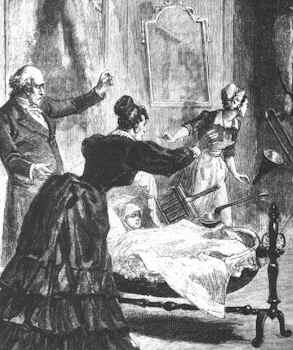 Until recently, poltergeists were thought to be typical personalities-that is, the ghosts of angry or mischievous individuals-but this idea has been challenged and, to a large degree, discarded. Once it was noticed that poltergeist activity normally centered around a single person—usually a young prepubescent girl or a high strung teenager—it was hypothesized that it was not ghosts that were doing the damage, but intense levels of highly charged telekinetic energy the victims themselves were putting out that were responsible for the phenomena.
In essence, a stressed youth was unconsciously moving objects through telekinesis (the ability to move objects with the power of the mind) which, in effect, made them both the perpetrator and the victim of a haunting at the same time! This explained not only why poltergeist activity abruptly ceases when a certain individual was no longer present, but why it sometimes followed them to other locations as well.
It also neatly explained why poltergeist hauntings rarely produced visual manifestations of ghostly apparitions, and why most activity stopped once the teenager reached adulthood.
On the surface, this seems an ironclad explanation for poltergeist activity, though it doesn't account for it all. While ghostly manifestations are rare at poltergeist hauntings, they are not unheard of, and there have even been cases of communication being made with spirit energies at a poltergeist site. In fact, poltergeist activity is often an element of many hauntings, suggesting that at least some of it may be the manifestations of malicious or mischievous spirits and not all of it the work of subconscious telekinetic energy.
Additionally, it doesn't account for why such a phenomena isn't more common considering how many stressed teenagers there are in the world, making its extreme rarity the best argument against the 'nervous' teenager theory. Finally, it doesn't answer the question of why if some living humans are potentially capable of moving objects through the power of the mind alone, there shouldn't be ghosts who are similarly capable of doing the same thing. In other words, if I am capable of telekinesis in the flesh, I should be capable of it from the 'other side' as well. As such, there is no real rationale why a ghost shouldn't be able to fling objects around as well as our earthbound mind can.
Despite these problems, however, it is enough to know that most paranormal investigators do not consider poltergeists to be actual ghosts, making the poltergeist less a 'type' of ghost than a form of telepathic anomaly. However, I think this is an issue that deserves more consideration by the parapsychology community before a final verdict is rendered, for the standard explanation poses as many questions as it attempts to answer.
Image source: http://lesbianpiratequeen.wordpress.com/2008/04/03
Source: http://www.ourcuriousworld.com/TypesofGhosts.htm